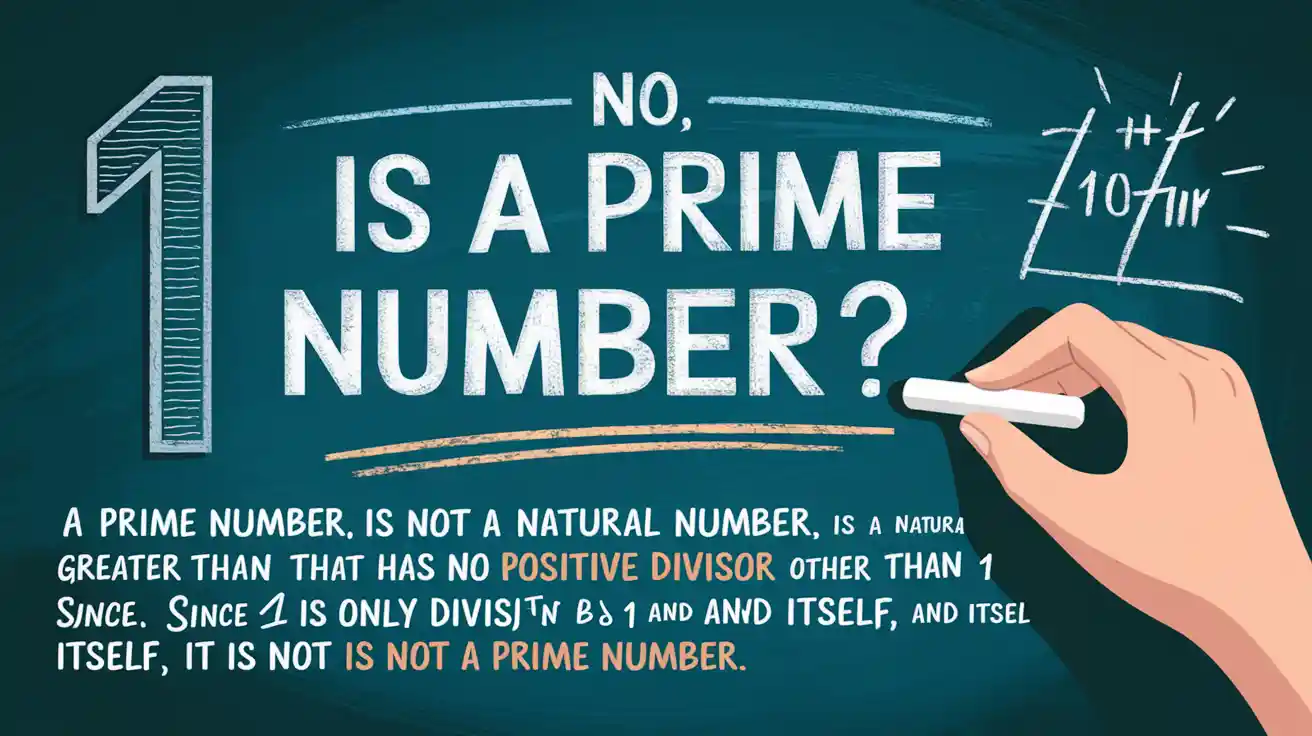
Is 1 a prime number? This is a question many children and even adults ask. It seems small and simple, but the answer is very important in math. Some people think 1 is a prime number because it can only be divided by itself. But is that really true?
In this blog post, we will talk about what prime numbers are and why 1 is different. We’ll explain everything in a fun and easy way, just like you’re learning in school. By the end, you will clearly understand is 1 a prime number and why it matters in math.
Is 1 a Prime Number? Let’s Find Out Together!
Many people ask, is 1 a prime number? It’s a question that sounds simple, but the answer may surprise you. Some kids think it is prime because 1 can only be divided by itself. But let’s take a closer look and learn what makes a number truly prime.
In math, a prime number means it has only two factors: one and itself. That means the number should have exactly two different numbers that divide it. For example, the number 2 is prime because only 1 and 2 can divide it. But the number 1 only has one factor—itself.
So, when we ask, is 1 a prime number, the answer is no. It does not meet the rule of having two different factors. This rule is very important in math. It helps us find patterns, do division, and even solve big problems in school and science.
What Is a Prime Number? Easy Definition for Kids
Let’s first understand what a prime number really is. A prime number is a number that has only two factors. That means it can only be divided by 1 and itself. For example, the number 3 is a prime number. You can divide it by 1 and by 3—but not by any other number.
If a number has more than two factors, it is not a prime number. For example, 4 is not prime. You can divide it by 1, 2, and 4. Since it has more than two factors, it is called a composite number. So, prime numbers are kind of like “special” numbers in math.
Many children think small numbers like 1 are prime. But now we know that for a number to be prime, it must have two factors—not just one. This is why 2, 3, 5, and 7 are prime numbers, but 1 is not. Don’t worry if it feels confusing at first. With practice, it gets easier!
Prime numbers are used in many parts of math. They help with division, multiplication, and even in computer coding. Knowing how they work makes math more fun and helps you solve problems faster.
Why 1 Is Not Called a Prime Number in Math
You might still wonder—is 1 a prime number or not? The answer is still no, and there’s a clear reason. A prime number must have two factors. But the number 1 only has one factor, which is just 1. So, it doesn’t fit the rule for being prime.
If we called 1 a prime number, it would break many math rules. For example, we couldn’t use prime numbers to build other numbers correctly. Prime numbers help us break down big numbers into smaller parts. This is called “prime factorization.” If 1 was included, things would get messy and confusing.
That’s why math experts decided long ago that 1 should not be called prime. It keeps math clean and easy to follow. By keeping 1 out of the list of prime numbers, we make sure that all math problems stay correct and simple.
So even though 1 is very special—it’s the first number we learn—it’s not a prime number. It plays a different role in math, and that makes it unique in its own way.
The History Behind Prime Numbers and Number 1
Long ago, smart people like Greek and Indian mathematicians studied numbers. They wanted to know which numbers are special. That’s when they found out about prime numbers. They saw that some numbers can only be divided by 1 and themselves. That’s how the idea of prime numbers started.
Back then, some people thought 1 was a prime number. But later, in the 1800s, math experts changed their minds. They saw that calling 1 a prime made math harder, not easier. So they made a new rule: 1 is not a prime number. This new rule helped everyone understand math better.
The number 1 is still very important in math history. It was the first number to be written and used in counting. Even though it’s not a prime number, it has a big job in math. Without 1, we couldn’t even begin to count or learn multiplication.
So, when you ask is 1 a prime number, history says no. But it’s still a number we need every day, and it will always be the first and most special number we learn.
How Teachers Explain Prime Numbers in School
In school, teachers try to make math easy and fun. When they talk about prime numbers, they often use small numbers to show examples. Like 2, 3, and 5. These are numbers that can’t be divided by anything except 1 and themselves.
To help kids understand, teachers use blocks, drawings, and number charts. They ask students to find numbers that have only two factors. It’s like a fun puzzle. But when they reach 1, the teacher says, “This number only has one factor, so it’s not a prime number.”
Many teachers also use real-life things to explain. For example, they might say, “Think of a prime number as a team that only has two members—1 and the number itself.” But number 1 only has one member. So it doesn’t fit on the prime team!
By learning this way, students understand clearly. So next time you wonder, is 1 a prime number, just remember what your teacher showed you: Prime numbers need two friends, and 1 is always alone!
Fun Ways to Remember Prime Numbers (And Why 1 Is Special)
Learning prime numbers can be fun when you play games. One way is to use a number chart from 1 to 100. You can color all the prime numbers, like 2, 3, 5, 7, and so on. This helps your brain remember them easily.
Another fun idea is to make a song or rhyme. For example, “Prime numbers shine, they only divide by one and their own line!” You can even make flashcards with numbers on them. On the back, you write “prime” or “not prime.”
The number 1 might look lonely because it’s not on the prime list. But don’t feel sad for it! It’s still very special. It starts every counting list. It helps us multiply and divide. Without 1, we would be lost in math!
So next time someone asks, is 1 a prime number, you can smile and say, “No, but it’s still a very important number!”
Is 1 a Prime Number or Just a Lonely Number?
Let’s think of numbers like a group of friends. Prime numbers are in a group where each number has only two best friends: 1 and itself. But poor number 1 doesn’t fit in this group. It only has one best friend—just itself!
That’s why 1 is not a prime number. It doesn’t meet the friend rule. It doesn’t have two different numbers that can divide it. So it has to stand outside the prime group. But that doesn’t mean it’s not important.
The number 1 is like the first block in a tower. It holds everything up. Even if it’s not part of the prime club, all numbers depend on it. Without 1, we wouldn’t even have 2, 3, or 5 to talk about!
So if you’re still wondering, is 1 a prime number, just remember—it’s not. But that doesn’t mean it’s not amazing in its own way.
Conclusion
Now you know the answer to the big question—is 1 a prime number? The answer is no. A prime number needs two factors, and 1 only has one. That’s why it does not belong to the prime number group.
But don’t worry! Even though 1 is not prime, it is still super important in math. It helps us start counting, multiplying, and learning new things. So remember, number 1 may be alone, but it’s never left out in math!
FAQs
Q: Is 1 a prime number?
A: No, 1 is not a prime number because it only has one factor—just itself.
Q: Why do prime numbers need two factors?
A: Prime numbers must be divided by 1 and the number itself. That means they have exactly two factors.
Q: Is 1 a composite number?
A: No, 1 is not composite either. Composite numbers have more than two factors, and 1 has only one.
Q: What is the first prime number?
A: The first prime number is 2. It can only be divided by 1 and 2.
Q: Why is 1 still important in math?
A: Number 1 is important because it starts all counting, helps in multiplication, and is used in many math rules.
About the Author


